




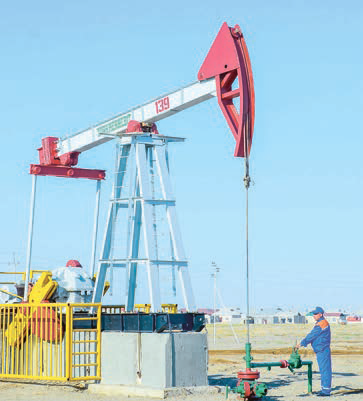
The commercial oil and gas potential of the Pliocene deposits in southwestern Turkmenistan, particularly the Red-Bed and Akchagyl-Apsheron strata, has been reliably established. Oil and gas fields in the Pliocene have been discovered onshore in the southwest of the country, as well as in the Turkmen sector of the Caspian Sea (the Balkan-Apsheron oil and gas bearing zone), in virtually all structures prepared for deep drilling using seismic exploration—specifically the reflection wave method (RWM) and the common depth point (CDP) method.
Within the Gögerendag-Ekerem gas-and-oil district, three zones of oil-and-gas-bearing lands are distinguished from west to east: the western zone — the Caspian zone, which holds great prospects; the central zone—the commercial oil-and-gas-bearing zone of Gögerendag – Gamyşlyja – Çekişler; and the eastern zone—Bugdaýly-Nogaý, which is potentially promising.
As noted, in the central zone, along the anticlinal line of the Gögerendag – Gamyşlyja – Akpatlawuk – Çekişler structures, all known uplifts have been studied, and commercial accumulations of oil and gas have been identified on each of them. In the eastern zone, one or two gas condensate accumulations (Nogaý, Bugdaýly) have been recorded in the lower Red-Bed deposits. The central zone contains large hydrocarbon reserves, while the other two, as indicated, await deep geophysical and drilling exploration.
The number of oil and gas deposits in traps not associated with anticlines also varies. Global experience across oil-and-gas-bearing provinces demonstrates that such traps contain a significant volume of proven oil and gas reserves and resources.
According to the publication, the search for deposits in non-anticlinal traps—lithologically and stratigraphically screened, in unconsolidated zones, and other features—remains a relevant task in the district. Such traps were formed as a result of the pinching out of productive complexes during the regional uplift of strata on the eastern side of the West Turkmen Basin. In southwestern Turkmenistan, non-anticlinal type deposits have been discovered at the Guyjyk, Altyguýy and other structures.
To identify new hydrocarbon accumulations in the lower Red-Bed deposits of the "old," well-studied Gogerendag-Ekerem district, the article notes that it is important to organize specialized comprehensive geological and geophysical works. These involve investigating the oil-and-gas-bearing lands located to the west and east of the central oil-and-gas-bearing zone.