


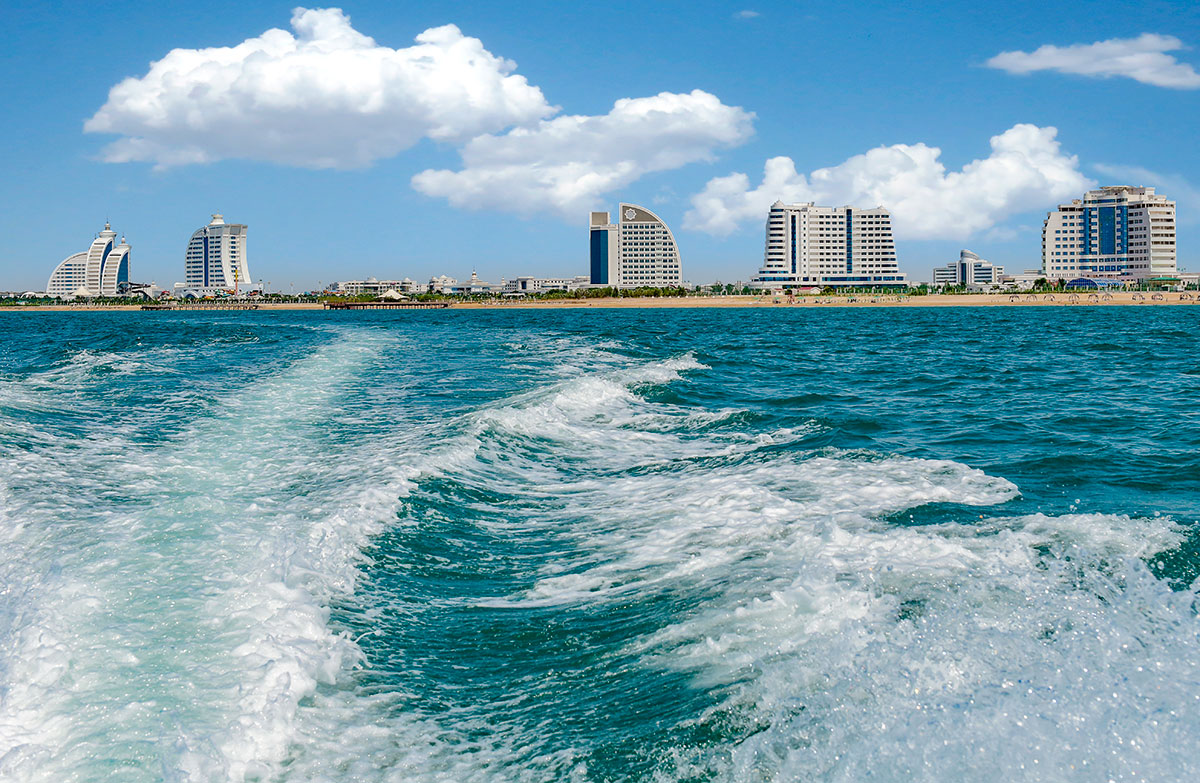
On August 12, Caspian Sea Day was solemnly celebrated in the National Tourist Zone «Awaza». The main event dedicated to Caspian Sea Day was the scientific-practical conference titled «Protection of the Caspian Sea Ecosystem: Regional Cooperation and Sustainable Development», which took place at the «Berkarar» Hotel in the National Tourist Zone «Awaza». The forum was attended by members of the Government of the country, heads and employees of various ministries and departments, specialists from relevant structures and scientific institutions of the country, as well as representatives of diplomatic missions accredited in Turkmenistan, along with international and regional organizations. An exhibition demonstrating the natural beauty of the Caspian Sea and the Motherland’s achievements in environmental protection was set up in the hotel lobby. At the opening ceremony of the forum, a welcoming Address by the President of Turkmenistan Serdar Berdimuhamedov to its participants was read out. As noted in the message, the Caspian Sea has gained broad international recognition as a sea of peace, friendship, and good-neighborly cooperation. It is an invaluable asset with unique natural features, rich biological diversity, and economic and geopolitical significance. Throughout history, the Caspian Sea has united the peoples living on its shores, creating favorable conditions for the development of trade, economic, cultural, and humanitarian ties between them. Noting that the preservation of the Caspian Sea's unique ecosystem, biodiversity, and rare species of flora and fauna is among our country's top priorities, Arkadagly Hero Serdar emphasized that Turkmenistan actively collaborates with international organizations and the states of the Caspian region. The Caspian Environmental Initiative, promoted by our country, represents an important step in protecting the marine ecosystem, uniting efforts, and preserving this unique natural asset for future generations. The welcoming Address of the President of Turkmenistan Serdar Berdimuhamedov to the participants of the scientific-practical conference was met with stormy applause from the audience. Next, speeches by the forum delegates were heard. As noted by the participants from the Turkmen side, in the Epoch of Revival of the New Era of the Powerful State, based on the noble initiatives of the Hero-Arkadag and under the wise leadership of Arkadagly Hero Serdar, an environmental policy aimed at harmonizing the Motherland's economic growth with environmental protection is being successfully implemented. In this regard, close attention is paid to issues of rational natural resource management, the introduction of environmentally friendly technologies and a «green» economy, ensuring environmental safety in the country and the region, and protecting biodiversity. Important initiatives aimed at developing trade, economic, cultural, and humanitarian ties in the Caspian region are being successfully implemented. All of them aim to transform the Caspian Sea into a zone of peace, trust, and environmental well-being, receiving broad support from the Caspian states as well as major international organizations. In this context, holding the First Caspian Summit in Ashgabat, as well as the First Caspian Environmental Forum and the First Caspian Economic Forum in the National Tourist Zone «Awaza», served as evidence of Turkmenistan's leading role in stepping up cooperation among the Caspian states. Furthermore, the Sixth Caspian Summit, held in Turkmenistan on June 29, 2022, became another important step in expanding the potential of partnership for the protection of the Caspian ecosystem. It was noted that our state's constructive initiatives—voiced from the rostrum of the United Nations General Assembly and other major forums—aimed at addressing environmental protection, the rational use of water and energy resources, and the creation of a reliable ecological defense system for the Caspian Sea, are gaining recognition across the entire international community. In this regard, particular emphasis was placed on the significance of the «Caspian Environmental Initiative», proposed by Turkmenistan at the 78th session of the United Nations General Assembly in 2023. It is designed to serve as an international platform for interaction on a wide range of tasks related to environmental protection, the Caspian Sea's bioresources, and the resolution of several ecological issues. Attention was focused on the importance of the proposal by the President of Turkmenistan Serdar Berdimuhamedov, voiced on September 23, 2025, at the plenary meeting of the 80th session of the United Nations General Assembly, to hold a Caspian Environmental Forum in 2026. This serves as clear confirmation of Turkmenistan's close attention to preserving the Caspian Sea ecosystem and will act as an important tool in uniting the efforts of Caspian states oriented toward environmental well-being. In recent years, the Turkmen coast of the Caspian Sea has turned into a hub for holding major international events. The National Tourist Zone «Awaza», created on the Caspian shore, is not only a vacation destination but also carries significant weight in terms of its positive impact on the environment. Today, this popular resort area serves as a model of a comprehensive and rational approach to using the region's mineral, biological, resort-sanatorium, and tourism potential. It should be noted that the key feature of all health resorts, hotels, and industrial enterprises built on the Caspian coast is their compliance with international environmental safety standards. The speeches also presented information on the work carried out by relevant government departments within the context of interstate and intergovernmental agreements approved by the five Caspian states. As noted, key tasks also include conducting regular monitoring of the Caspian's biological resources and the state of the marine environment, as well as carrying out a broad range of scientific research. A vital role in preserving and studying the sea's plant and animal life is played by the «Hazar» State Nature Reserve, which protects rare and endangered species of plants and animals inhabiting the Caspian region, including the Caspian seal, various species of fish, birds, and other wildlife. Additionally, scientific research is conducted here to study marine flora and fauna, monitor ecosystem conditions, and develop protective measures. Floor time was then granted to representatives of foreign embassies in Turkmenistan, as well as international and regional organizations. It was emphasized that the Caspian Sea is a sea of friendship, peace, security, cooperation, and harmony, uniting the economic potential and expanding the traditional ties of the region's countries. Friendly relations and the consistent strengthening of interaction among the Caspian states serve as a solid foundation for peace and sustainable development in the region. The coastal states fully support all efforts aimed at preserving the Caspian Sea as a space of peace and good-neighborliness. The Caspian Summits held with the participation of heads of state and government, the Caspian Economic Forums, meetings at the foreign minister level, and other events contribute to the successful development of five-sided cooperation. Trade, economic, and transport cooperation among the Caspian states is also expanding systematically. In particular, great importance is attached to developing the Trans-Caspian International Transport Route—the primary route connecting Europe with Central Asia—which helps expand economic ties between countries in the region and reduce cargo transit times. It was noted that currently, due to climate change, the Caspian Sea is also subject to environmental threats, requiring a science-based, joint approach. Thus, the decline in the Caspian Sea level was one of the key issues at the Sixth Caspian Summit held in 2022 in Ashgabat. In addition, issues related to preventing falling sea levels were discussed during meetings organized within the framework of the Third United Nations Conference on Landlocked Developing Countries, which was organized at Turkmenistan's initiative in the National Tourist Zone «Awaza». Conference participants highly praised the initiatives implemented by Turkmenistan in this direction and the favorable opportunities created for fruitful joint work. The significance of the «Awaza» Programme of Action for 2024–2034 and the Avaza Political Declaration, adopted within the framework of the Third United Nations Conference on Landlocked Developing Countries, was particularly highlighted. As noted, the structural transformations and measures outlined in the «Awaza» Programme of Action regarding trade and economic partnership, regional integration, transit communications, transport connectivity, and climate change adaptation are of vital importance for both the Caspian region and Central Asia. The speeches also emphasized the importance of Turkmenistan's international environmental initiatives. According to general consensus, Turkmenistan's accession to the Global Methane Pledge, as well as its initiatives to establish a Regional Center for Climate Change Technologies in Central Asia and a Regional Center to Combat Desertification, demonstrate a firm commitment to cooperation in environmental protection and climate action. During the conference, an overview of the work accomplished over the past 20 years under the Framework Convention for the Protection of the Marine Environment of the Caspian Sea (Tehran Convention) was also presented. The uniqueness of the Convention lies in the fact that it is the first legally binding international instrument regulating relations among Caspian states in the field of ecology and rational natural resource management. The Convention allows for a precise definition of the parties' obligations and rapid responses to environmental threats through dedicated protocols adopted under its framework. The Tehran Convention serves as a core platform for interstate cooperation in key areas such as preventing pollution during the exploration, extraction, and transportation of hydrocarbon resources, monitoring the marine environment, conducting joint scientific research, and assessing environmental impact. Focusing on the need for a comprehensive approach to tasks arising from the Tehran Convention, speakers emphasized the importance of consolidating efforts to meet outlined goals, as well as further expanding interaction between relevant agencies and specialists. In this context, proposals were voiced to strengthen regional scientific networks, expand information exchange, and create a Caspian Scientific Partnership that would bring together research institutes from across the region. At the same time, the importance of adopting innovations, modern technologies, new monitoring methods, and solutions like artificial intelligence and information platforms was highlighted. In this regard, the significance of Turkmenistan's initiative to establish a Regional Center for Climate Change Technologies in Central Asia was noted. The Center could transform into a platform bridging policy, science, finance, and innovation, accelerating climate adaptation, water resource management, renewable energy development, and ecosystem restoration. The speeches also highlighted the role of youth in fighting climate change and ensuring ecological well-being. As is known, young people worldwide are actively engaged in the climate agenda, bringing forward environmental initiatives. Expanding youth opportunities in the Caspian region is not only an investment in the future but also a key factor in implementing timely solutions. Summarizing the outcomes of the forum, participants emphasized that Caspian Sea Day, celebrated in the Caspian countries, is a date that once again focuses attention on the importance of strengthening cooperation, peace, and trust in the region. Attendees reaffirmed the need to further promote international collaboration to ensure reliable ecological protection for the Caspian Sea and realize its potential for universal well-being and progress. At the conclusion of the conference, participants adopted an Address to the President of Turkmenistan, Serdar Berdimuhamedov, expressing gratitude for important initiatives to develop trade, economic, social, and cultural ties in the Caspian region, to transform the Caspian Sea into a zone of peace, trust, and environmental well-being, and for effective measures to step up cooperation among the Caspian states. Thus, the scientific-practical conference «Protection of the Caspian Sea Ecosystem: Regional Cooperation and Sustainable Development» served as another confirmation of Turkmenistan's successfully implemented environmental diplomacy, acting as an effective platform for ongoing measures to ensure regional environmental stability and coordinate the joint efforts of Caspian states to preserve the Caspian's unique ecosystem, biodiversity, and natural wealth.




Turkmenistan’s environmental diplomacy: the future of the Caspian Sea discussed in Avaza
13 Aug 26